










Monday, 9 March 2026
Two different levels of analysis: the hippocampus at the neuronal level and autism at the molecular level
This week, I’ll address two different topics from the angle that is so central to my website and my book about the human brain: the various levels at which the human brain and the human mind are organized. My first topic today is how the neurons of the hippocampus are affected by chronic stress. The second is how the lower availability of a certain type of neurotransmitter receptor in widespread regions of the brain may contribute significantly to traits of autism.
* * *
Sometimes, day-to-day stress can stretch out over weeks, months or even years. Such chronic stress places us in a state of what French neurobiologist Henri Laborit called “action inhibition “. Let me explain. Our human brains originally evolved to react to sudden physical threats by preparing our bodies to either fight them or run away from them. But in today’s world, many of the threats that we face are essentially verbal and occur in family or work settings where we can neither fight nor flee. Instead, we do nothing about these threats and hope that they will pass. When instead they persist, so do our ingrained physiological responses, for longer than they were ever meant to, thus causing harm to both our bodies and our brains.
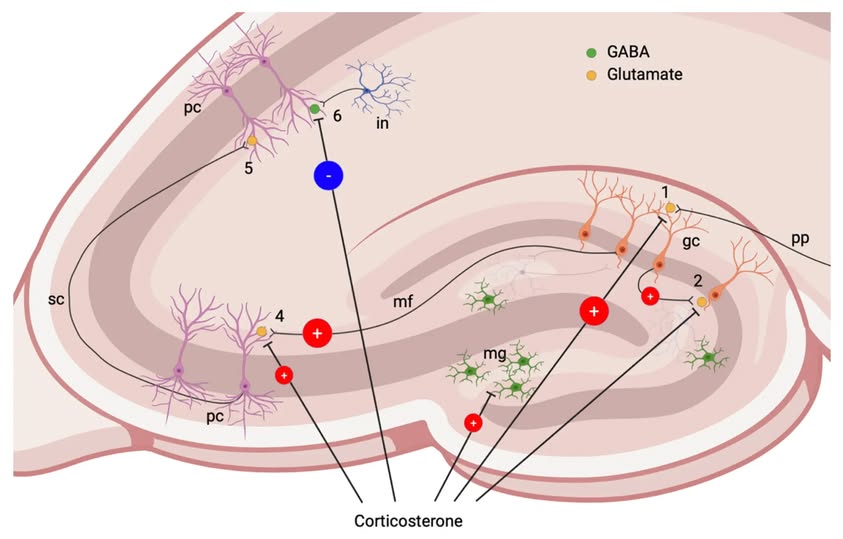
As has long been known, one of the parts of the brain that are most strongly affected by chronic stress is the hippocampus, an ancient structure that is located in the medial temporal lobe and is involved in spatial declarative memory. The website Better Brain, which I discovered recently, regularly posts superb graphics about various aspects of the brain on its Facebook page, including the one reproduced above, about the effects of glucocorticoids (stress hormones) on the neurons of the hippocampus. This single image provides a great summary of an article entitled “Brain trauma, glucocorticoids and neuroinflammation: Dangerous liaisons for the hippocampus”, published in the journal Biomedecines in 2022. This image shows at a glance how the glutocorticoid corticosterone alters the functioning of the hippocampus by stimulating or inhibiting some of its neurons, resulting in excessive activity of the hippocampus as a whole. (Just one small criticism of this graphic: it shows the excitatory effects in red and the inhibitory effects in blue, whereas the usual convention is actually the reverse.)
* * *
The other topic that I wanted to tell you about today comes from an article published in the American Journal of Psychiatry in December 2025, entitled “Imaging Metabotropic Glutamate Receptor 5 and Excitatory Neural Activity in Autism. The title of the press release about this article in Neuroscience News is far more straightforward and maybe goes too far: Missing Brain Receptor May Hold the Key to Autism. Let’s set aside the idea that any single “key” can explain such a complex phenomenon as autism or the autism spectrum. But the discovery reported in this article is still interesting, because it shows that the brains of people with autism have fewer of a certain type of receptors for glutamate, the most widespread neurotransmitter in the brain. The lower availability of these receptors may be associated with various traits of autism. It is also compatible with the theory that an imbalance in the excitatory and inhibitory signals passing between neurons may contribute to the symptoms of autism, which is what makes this study’s findings of interest. I will also add in passing that this study again confirms the inextricable links among what happens at the molecular, cellular, psychological and behavioural levels in all animals.
Mental Disorders | Comments Closed
